CSSA System
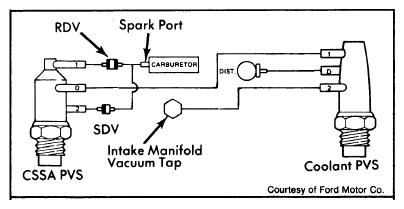
- Using a vacuum "T", connect a vacuum gauge in-line with distributor vacuum advance. Start engine. Open throttle to about 2500 RPM and release throttle while observing vacuum gauge.
- With engine coolant temperature below 125°F, vacuum should rise with throttle opening, then fall slowly as vacuum is passed through RDV. If vacuum falls quickly, replace RDV.
- With engine temperature between 125°F and 235°F, ported vacuum should be delayed as throttle is opened, and fall with throttle closing. If vacuum is not delayed as throttle is opened, replace SDV. If vacuum reading in steps 2 and 3)
are identical (same or no delay), CSSA PVS is defective.
- Coolant PVS can be checked (if necessary) by causing engine coolant temperature to rise above 235°F. Coolant PVS should close ported vacuum port and open intake manifold port to distributor vacuum advance. If coolant PVS does not switch to manifold vacuum above 235°F, then switch back to ported vacuum when coolant temperature falls below 235°F, replace PVS.
 Courtesy of FORD MOTOR CO.
NOTE:
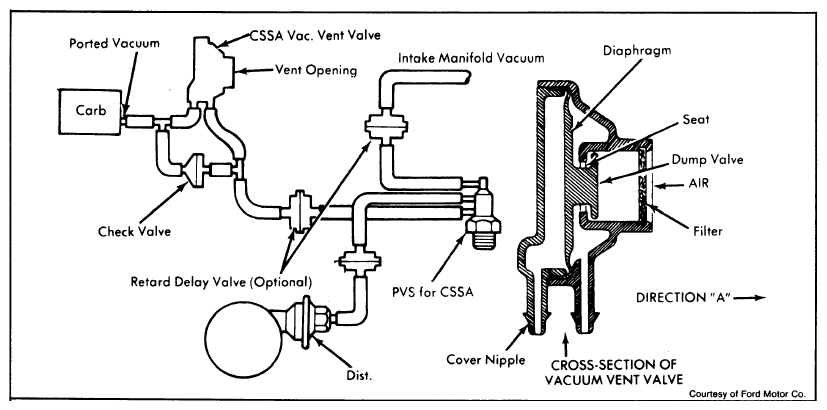
Some 1977 F150-350 models with 351" or 400" engines (Calibration No. 7-71J-R1, 7-72J-R1, and 7-74J-R1) have a modified CSSA system. The modification incorporates a vacuum vent valve that prevents unnecessary fuel transfer from the carburetor spark port into the distributor vacuum system by dumping vacuum to the atmosphere. See Fig 2.
When vacuum is applied to vent valve diaphragm, the vacuum vent valve closes and the check valve opens to actuate the distributor diaphragm. The vent valve momentarily dumps vacuum to the atmosphere when CSSA ported vacuum switch changes from a manifold vacuum signal to a ported vacuum signal. The vent valve will also dump vacuum to the atmosphere when ported vacuum signal is weak, during closed throttle, and during wide open throttle. When ported vacuum is low, the diaphragm relaxes and the dump valve opens.
 Courtesy of FORD MOTOR CO.