Diagnostic Procedure
- Check Shift Interlock In ACC Position
- Turn ignition to ACC position. With brake pedal released, try and move selector lever to "R" position. If lever moves to "R" position, go to step 3. If lever does not move to "R" position, go to next step.
- Check System Operation
- Turn ignition on. Depress brake pedal and move selector lever to "R" position. If lever does not move to "R" position, go to step 4. If lever moves to "R" position, system is operating normally. Check wiring harness and connectors for intermittent operation.
- Check Steering Column Adjustment
- Actuate steering column adjustment switch to tilt or telescope position. If steering column adjusts, go to next step. If steering column does not adjust, diagnose communication problem with SCIL Module. See appropriate MODULE COMMUNICATION NETWORK article in ACCESSORIES & EQUIPMENT.
- Check Stoplight Operation
- Connect NGS scan tool to Datalink connector. Select SCIL PID BOO _ SCI display. While monitoring scan tool display, depress brake pedal. If PID BOO _ SCI changes from off to on, go to next step. If PID BOO _ SCI does not change, diagnose BOO/BPP switch circuit. See appropriate EXTERIOR LIGHTS article in ACCESSORIES & EQUIPMENT.
- Check SCIL Module Output To Shift Interlock Solenoid
- Turn ignition off. Locate and disconnect shift interlock solenoid connector. Turn ignition on. Connect DVOM between shift interlock solenoid harness connector Light Blue/Black wire and ground. On NGS scan tool, select SCIL MODULE ACTIVE COMMAND BRAKE SYSTEM. While measuring voltage with DVOM, activate BRK/SHIFT on NGS scan tool. If battery voltage is present, go to step 8. If battery voltage is not present, go to next step.
- Check Light Blue/Black Wire For Short To Ground
- Turn ignition off. Locate and disconnect SCIL module connector. Using DVOM, measure resistance between SCIL module connector C287 terminal No. 9 and ground. See Fig 1 and Figure.
If resistance is more than 10 k/ohms, go to next step. If resistance is less than 10 k/ohms, repair short Light Blue/Black wire between SCIL module connector and shift interlock solenoid connector.
- Check Light Blue/Black Wire For Open
- Using DVOM, measure resistance of Light Blue/Black wire between SCIL module terminal No. 9 and shift interlock solenoid connector. If resistance is less than 5 ohms, replace SCIL module. Reconnect all connectors and retest system. If resistance is more than 5 ohms, repair open in Light Blue/Black wire.
- Check Shift Interlock Solenoid Ground For Open
- Using DVOM, measure resistance between shift interlock solenoid connector Black wire and ground. If resistance is less than 5 ohms, replace shift interlock solenoid. Reconnect all connectors and retest system. If resistance is more than 5 ohms, repair open Black wire between shift interlock solenoid connector and ground.
- Check Signal To Shift Interlock Solenoid
- Disconnect shift interlock solenoid connector. Using DVOM, measure voltage between shift interlock solenoid connector Light Blue/Black wire terminal and ground. If battery voltage is present, go to next step. If battery voltage is not present, replace shift interlock solenoid. Reconnect all connectors and retest system.
- Check SCIL Module For Short To Power
- Disconnect SCIL module connector. Using DVOM, measure voltage between Light Blue/Black wire and ground. If battery voltage is present, repair short in Light Blue/Black wire. Reconnect all connectors and retest system. If battery voltage is not present, replace SCIL module. Reconnect all connectors and retest system.
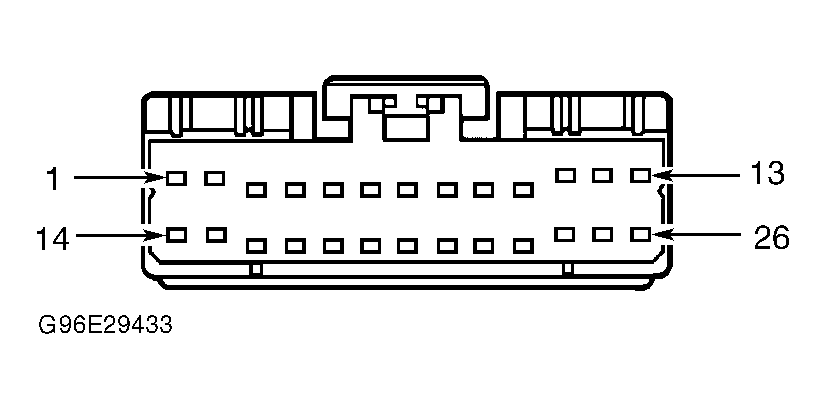 Courtesy of FORD MOTOR CO.