Retrieving Codes
- Perform DIAGNOSTIC CIRCUIT CHECK before diagnosing vehicle using self-diagnostic system. See DIAGNOSTIC CIRCUIT CHECK chart in this article.
- Trouble code(s) can be retrieved through either one of the 2 diagnostic switch terminals. See Fig 1
. One is located in the monitor connector in engine compartment and the other one is in the fuse block, located in the passenger compartment.
- To retrieve code(s) using the diagnostic terminal in fuse block, insert spare fuse into diagnostic switch terminal. The ECM will toggle the CHECK ENGINE light, flashing code(s).
- To retrieve code(s) using the monitor connector in the engine compartment, ground terminal "B" (diagnostic switch terminal) of connector. The ECM will then output self-diagnostic code(s). Both these diagnostic terminals, when grounded, sets the ignition timing to base timing.
- If no trouble codes exist, the ECM will flash Code 12. If trouble codes are stored, the lowest numbered code will be given first. Each code will be displayed 3 times. Proceed to CODE CHARTS for diagnosing stored codes.
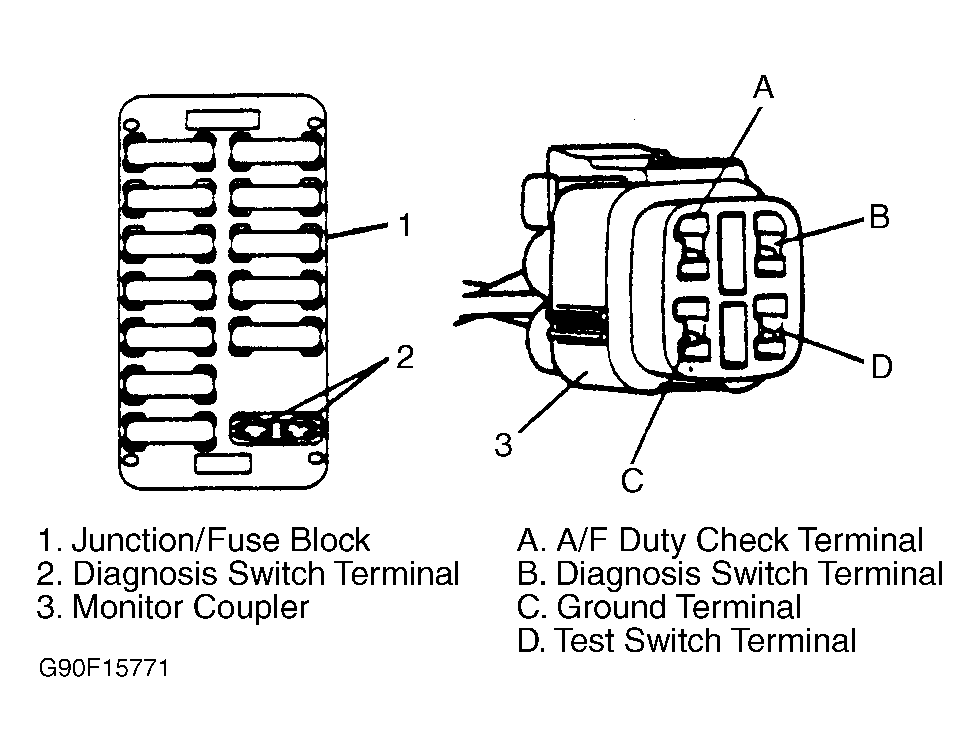 Courtesy of GENERAL MOTORS CORP.
 TROUBLE CODE IDENTIFICATION CHART
| Code |
Circuit Affected |
Probable Cause |
| 12 |
System Is Normal |
- |
| 13 |
Oxygen Sensor |
Open Circuit |
| 14 |
Coolant Temp. Sensor |
High Temp. Indicated |
| 15 |
Coolant Temp. Sensor |
Low Temp. Indicated |
| 21 |
Throttle Switch |
Both Idle Switch Throttle Switch ON |
| 21 |
Throttle Position Sensor |
Signal Voltage High |
| 22 |
Throttle Position Sensor |
Signal Voltage Low |
| 23 |
Manifold Air Temp. Sensor |
Low Temp. Indicated |
| 24 |
Vehicle Speed Sensor |
No Speedometer |
| 25 |
Manifold Air Temperature |
High Temp. Indicated |
| 31 |
MAP Sensor |
Signal Voltage Low With High Vacuum |
| 32 |
MAP Sensor |
Signal Voltage High With Low Vacuum |
| 41 |
Ignition Signal |
No Signal |
| 42 |
Crank Angle Sensor |
No Signal For 2 Seconds |
| 51 |
EGR System |
EGR VSV Inoperative |