Fuel Pressure Test
- Ensure battery is fully charged and ignition switch is off. Relieve fuel system pressure. See FUEL PRESSURE RELEASE. Remove banjo bolt from cold start injector fuel line.
- Install Fuel System "T" Fitting Adapter (J-38347) with 2 new gaskets. Install Fuel Pressure Gauge (J-34730-B). Install jumper wire between "B+" terminal and Fuel Pump (FP) terminal of diagnostic connector, located on left strut tower. Check for fuel leaks. See Fig 1
.
- Turn ignition switch on. Open fuel pressure gauge shut-off valve. Open gauge air-purge valve to bleed trapped air/fuel into container.
- With fuel pump operating and engine off, fuel pressure should be 38-44 psi (2.7-3.0 kg/cm2
). Maximum fuel pressure (fuel line pinched) should be more than 57 psi (3.9 kg/cm2
). With ignition and fuel pump off, fuel pressure should remain at more than 21 psi (1.5 kg/cm2
) for at least 5 minutes. Start engine to measure fuel pressure with engine idling. Fuel pressure should be 30-33 psi (2.0-2.3 kg/cm2
).
- If pressure is not within specification, check for defective fuel pump, pressure regulator or restriction in fuel system. Repair as necessary. Remove pressure gauge. Start engine and ensure no fuel leaks exist.
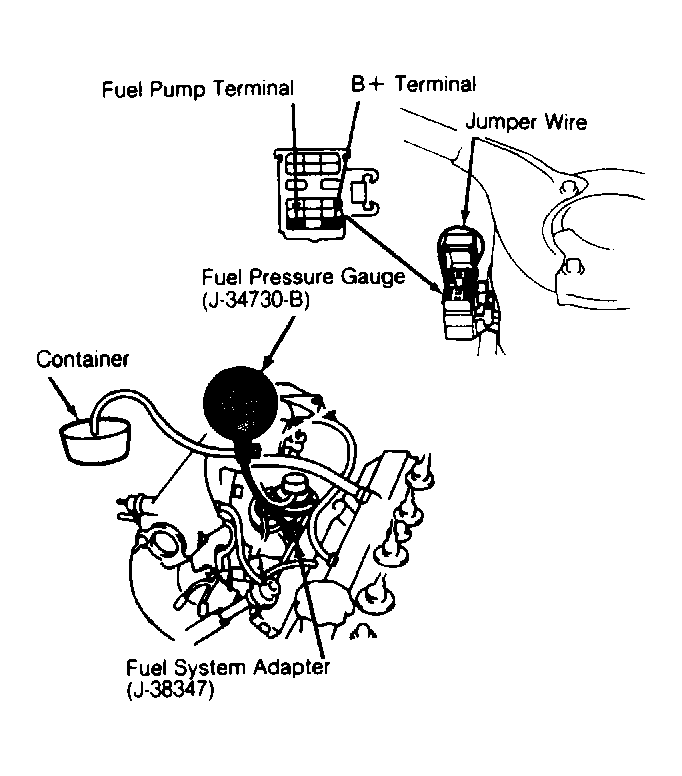 Courtesy of GENERAL MOTORS CORP.
 REGULATED FUEL PRESSURE
| Application |
Pressure psi (kg/cm2
) |
| Prizm & Prizm GSi |
30-44 (2.7-3.0) |
UNREGULATED FUEL PRESSURE
| Application |
Pressure psi (kg/cm2
) |
| Prizm & Prizm GSi |
38-44 (2.7-3.1) |
MAXIMUM FUEL PRESSURE
| Application |
Pressure psi (kg/cm2
) |
| Prizm & Prizm GSi |
More Than 57 (3.9) |
REST FUEL PRESSURE
| Application |
Pressure psi (kg/cm2
) |
| Prizm & Prizm GSi |
More Than 21 (1.5) |