Retrieving Codes
- Using a jumper wire, connect Blue/Yellow and Black wires of diagnostic connector. Diagnostic connector is located in engine compartment, near battery. See Fig 1
. Turn ignition switch to ON position. Read fault code(s). Proceed to appropriate chart(s) under DIAGNOSTIC CODE CHARTS to diagnose fault codes.
- If no fault codes are stored, CHECK ENGINE light will flash on and off rapidly until jumper wire is removed. Count the number of flashes and look for pauses in flashing to ensure no fault codes are overlooked. If fault codes are stored, code will flash 3 times starting with the lowest code.
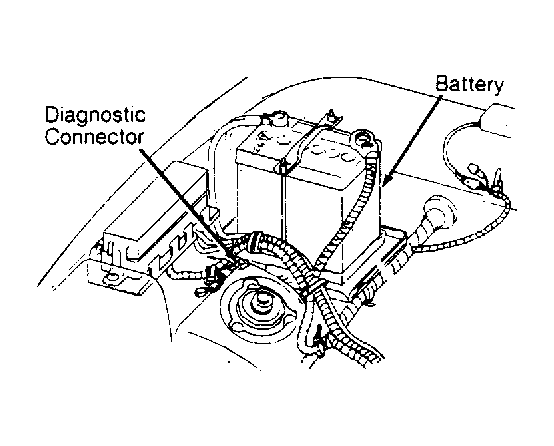 Courtesy of GENERAL MOTORS CORP.
 FAULT CODE IDENTIFICATION
| Code |
Circuit Affected |
Probable Cause |
| 13 |
Oxygen Sensor |
Open Circuit |
| 14 |
Coolant Temp. Sensor |
Low Temp. Indicated |
| 15 |
Coolant Temp. Sensor |
High Temp. Indicated |
| 21 |
Throttle Switch |
Idle Switch & Throttle Switch Are On |
| 21 |
Throttle Position Sensor |
Signal Voltage High |
| 22 |
Throttle Position Sensor |
Signal Voltage Low |
| 23 |
Intake Air Temp. Sensor |
Low Temp. Indicated |
| 24 |
Vehicle Speed |
Incorrect Signal Voltage |
| 25 |
Intake Air Temp. Sensor |
High Temp. Indicated |
| 31 |
MAP Sensor |
Signal Voltage High, Low Voltage |
| 32 |
MAP Sensor |
Signal Voltage Low, High Vacuum |
| 41 |
Ignition Signal |
No Signal |
| 42 |
Crank Angle Sensor |
No Signal |
| 44 |
Idle Switch |
Open/Misadjusted TPS |
| 45 |
Idle Switch |
Ground/Misadjusted TPS |
| 51 |
EGR System |
Out Of Calibration |