Pressure Testing
- Disconnect negative battery terminal. Release fuel pressure. See FUEL SYSTEM PRESSURE RELEASE
. Connect Fuel Pressure Gauge (07406-0040001
) at 6-mm bolt. Reconnect negative battery terminal. Start engine, and note fuel pressure. If vehicle will not start, check for spark. If spark is present and no fuel pressure is evident, inspect fuel pump main relay.
- Remove connector from fuel pump main relay. See Fig 1
. Using a test light, check power on Black/Yellow wire at fuel pump relay connector. If power is present, go to next step. If power does not exist, repair open wire between fuel pump main relay connector and fuse No. 2 on fuse box. Go to step 4).
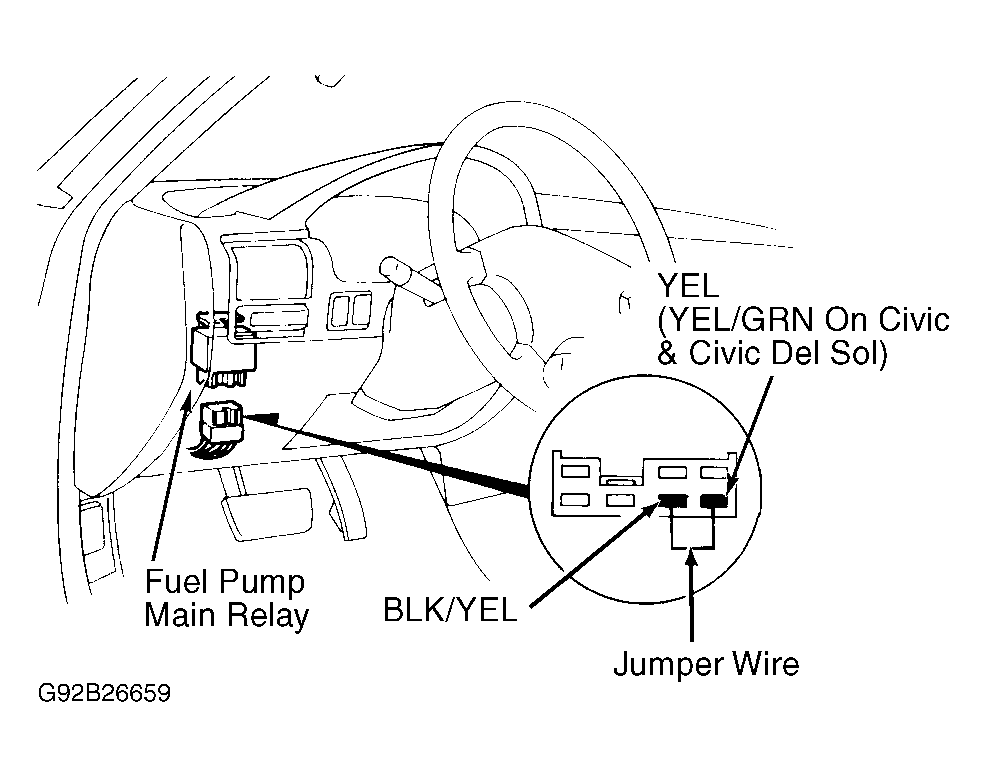 Courtesy of AMERICAN HONDA MOTOR CO., INC.
- Connect jumper wire between Black/Yellow wire (B+) and Yellow wire. If fuel pump runs, go to next step. If fuel pump fails to run, see SYSTEM/COMPONENT TESTS - 2.2L
article.
- Start engine. Disconnect vacuum hose from pressure regulator, and check for manifold vacuum. If vacuum is not present, check for restriction in vacuum port or hose. Plug vacuum hose and inspect fuel pressure gauge reading. Gauge reading should be within specification. See REGULATED FUEL PRESSURE
. Pressure should drop slightly when vacuum hose is reconnected.
REGULATED FUEL PRESSURE
| Application |
At Idle psi (kg/cm2
) |
| Accord |
| Vacuum Hose Disconnected |
40-47 (2.8-3.3) |
| Vacuum Hose Connected |
30-37 (2.1-2.6) |
| Odyssey |
38-46 (2.7-3.2) |
| Prelude |
| F22A1 |
| Vacuum Hose Disconnected |
36-43 (2.5-3.0) |
| Vacuum Hose Connected |
24-31 (1.7-2.2) |
| H22A1 |
| Vacuum Hose Disconnected |
33-40 (2.3-2.8) |
| Vacuum Hose Connected |
25-32 (1.8-2.3) |