Key Interlock System
- Remove screws from lower steering column cover. Remove upper and lower steering column covers. Disconnect the key switch connector (5-pin) from the steering lock assembly.
- Turn the ignition switch to ACC (I) or ON (II) position.
- Connect the No. 4 terminal of the key switch connector to the battery positive terminal, and connect the No. 5 terminal to the battery negative terminal. See Fig 1.
- Check the key interlock solenoid operation. A clicking sound should be heard while pushing the ignition key in, and you should not be able to turn switch to the OFF position. Does the key interlock solenoid operate properly? If yes, go to next step. If no, key interlock solenoid/switch is faulty. Replace the ignition key cylinder/steering lock assembly. See appropriate STEERING COLUMNS article in STEERING.
- Check for continuity between the No. 3 and 4 terminals. Is there continuity while pushing the key in, and no continuity when the key is released? If yes, go to next step. If no, replace the ignition key cylinder/steering lock assembly. See appropriate STEERING COLUMNS article in STEERING.
- Measure the voltage between key switch assembly 5-pin connector terminal No. 4 and body ground. Is there battery voltage? If yes, go to next step. If no, check for a blown No. 6 (10-amp) fuse in the under-hood fuse/relay box. If the fuse is okay, repair open or short in the wire between key switch assembly 5-pin connector terminal No. 4 and the underhood fuse/relay box.
- Measure the voltage between the No. 3 and 4 terminals of the steering lock assembly connector (6-pin). Shift lever must be in "P" position. Is there battery voltage with shift lever in "P" position and zero volts with shift lever out of "P" position? If yes, go to next step. If no, check for open or short in the wire between the No. 3 terminal of steering lock assembly connector and the gauge assembly. See WIRING DIAGRAMS . If wires are okay, check for a loose terminal fit in the gauge assembly connectors. If necessary, substitute a known-good gauge assembly and recheck. See appropriate INSTRUMENT PANELS article in ACCESSORIES & EQUIPMENT.
- Move the shift lever back to "P" position, and measure the voltage between steering lock assembly connector terminals No. 4 and 5. See Fig 1. Is there battery voltage with shift lever in "P" position and zero volts with shift lever out of "P" position? If yes, check for a loose terminal fit in the gauge assembly connectors. If necessary, substitute a known-good gauge assembly and recheck. See appropriate INSTRUMENT PANELS article in ACCESSORIES & EQUIPMENT. If no, go to next step.
- Remove front console. See FRONT CONSOLE under REMOVAL & INSTALLATION.
- Disconnect the park pin switch connector (4-pin). See PARK PIN SWITCH under COMPONENT TESTS.
- Check for continuity between the No. 3 and No. 4 terminals of the park pin switch connector (4-pin) while you move the shift lever in and out of the "P" position. See Figure. Is there continuity with the shift lever in the "P" position, and no continuity with the shift lever in any position other than "P"? If yes, repair open or short in the wires between the park pin switch connector and the steering lock/key switch assembly. If no, replace the park pin switch. See PARK PIN SWITCH under REMOVAL & INSTALLATION.
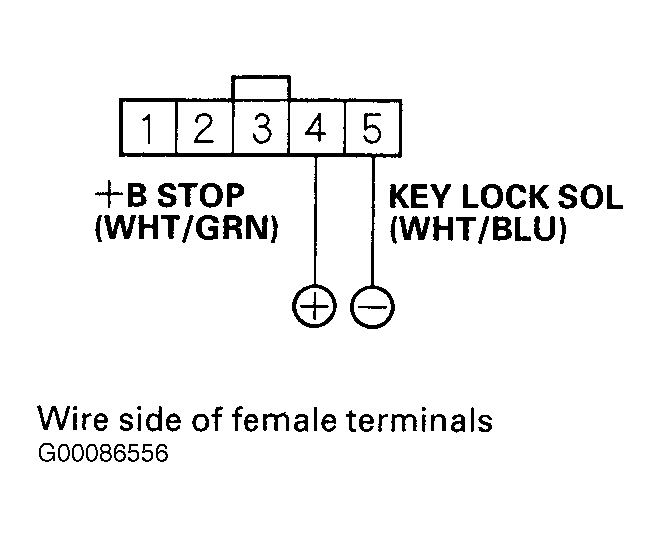 Courtesy of AMERICAN HONDA MOTOR CO., INC.