Intake Air Control System (Prelude)
- Start engine and allow to idle. Disconnect vacuum hose from upper port of intake control solenoid valve located at right side of engine, under intake duct. Connect vacuum pump/gauge to intake control solenoid valve. See Fig 1. Check for vacuum at intake control solenoid valve. If vacuum does not exist, go to next step. If vacuum exists, go to step 6.
- Reconnect vacuum hose to upper port of intake control solenoid valve. Disconnect vacuum hose from intake control vacuum tank. See VACUUM DIAGRAMS article. Check for vacuum at open hose of intake control vacuum tank. If vacuum exists, go to next step. If vacuum does not exist, check for blockage or vacuum leak between intake control vacuum tank and intake manifold.
- Turn ignition off. Disconnect intake control solenoid valve 2-pin connector. Turn ignition on. Measure voltage between intake control solenoid valve connector terminals. If battery voltage does not exist, go to next step. If battery voltage exists, replace intake control solenoid valve.
- Measure voltage between body ground and intake control solenoid valve connector terminal No. 2 (Black/Yellow wire). If battery voltage exists, go to next step. If battery voltage does not exist, repair open in Black/Yellow wire between intake control solenoid valve connector and No. 14 (15-amp) fuse located in underdash fuse/relay box. See WIRING DIAGRAMS article.
- Turn ignition off. Reconnect intake control solenoid valve 2-pin connector. Turn ignition on. Backprobing, connect a jumper wire between PCM connector "A" (32-pin connector) terminals No. 9 (Brown/Black wire) and No. 25 (White wire). See Figure. If intake control solenoid valve does not click when jumper wire is connected, repair open in White wire between intake control solenoid valve and PCM connectors. If intake control solenoid valve clicks when jumper wire is connected, substitute a known-good PCM and retest. See SUBSTITUTING POWERTRAIN CONTROL MODULE under SELF-DIAGNOSTIC SYSTEM in SELF-DIAGNOSTICS - PRELUDE article. If symptom or indication goes away, replace original PCM.
- Increase engine speed to above 4200 RPM. Check for vacuum at intake control solenoid valve. See Fig 1. If vacuum exists, go to next step. If vacuum does not exist, go to step 9.
- Turn ignition off. Disconnect intake control solenoid valve 2-pin connector. Again, check for vacuum at intake control solenoid valve. If vacuum does not exist, go to next step. If vacuum exists, replace intake control solenoid valve
- Turn ignition off. Disconnect PCM connector "A" (32-pin connector). Check for continuity between body ground and intake control solenoid valve 2-pin connector terminal No. 1 (White wire). If continuity exists, repair short in White wire between intake control solenoid valve and PCM connectors. See WIRING DIAGRAMS article. If continuity does not exist, substitute a known-good PCM and retest. See SUBSTITUTING POWERTRAIN CONTROL MODULE under SELF-DIAGNOSTIC SYSTEM in SELF-DIAGNOSTICS - PRELUDE article. If symptom or indication goes away, replace original PCM.
- Apply vacuum to vacuum hose disconnected from intake control solenoid valve upper port. See Fig 1. If vacuum holds, intake control system is okay at this time. If vacuum does not hold, check vacuum hoses for proper connections and/or disconnected, cracked or leaking hoses. If vacuum hoses are okay, replace intake control diaphragm.
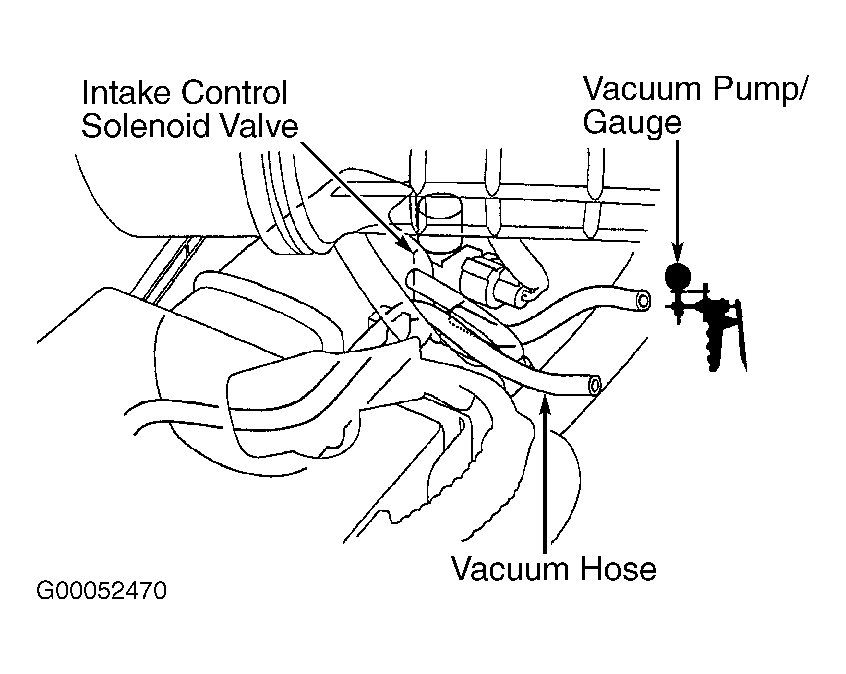 Courtesy of AMERICAN HONDA MOTOR CO., INC.