Spark Test
- Turn ignition off. Check ignition coil, ignitor and distributor connectors. Repair as necessary. If connectors are okay, go to next step.
- Using an ohmmeter, check resistance of high tension cables. Maximum resistance allowed is 25,000 ohms per cable. Replace as necessary. If resistance is within specification, go to next step.
- Turn ignition on. Using a DVOM, ensure battery voltage is present at ignition coil positive terminal. If battery voltage is not present, check wiring between ignition switch and ignition coil. If battery voltage is present, go to next step.
- Turn ignition off. Using a DVOM, measure resistance of ignition coil (cold). Primary resistance is .41-.50 ohm. Positive terminal on ignition coil has a tab next to terminal. Secondary resistance is 10,200-13,800 ohms. If resistance is not within specification, replace ignition coil. If resistance is within specification, go to next step.
- Measure resistance of pick-up coil. See Fig 1. Measure resistance between terminals G1 and G-, G2 and G-, and NE and G-. Resistance should be 140-180 ohms. If resistance is not within specification, replace distributor housing assembly.
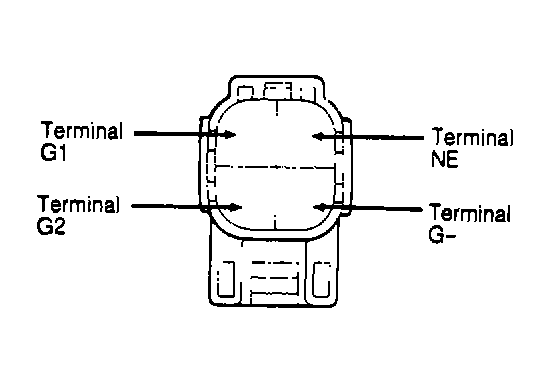 Courtesy of © TOYOTA, LICENSE AGREEMENT TMS1002
- Check air gap in distributor. Measure air gap of G1 pick-up, G2 pick-up and NE pick-up. See Fig 2. Air gap specification is .008" (.20 mm). If air gap is not to specification, replace distributor.
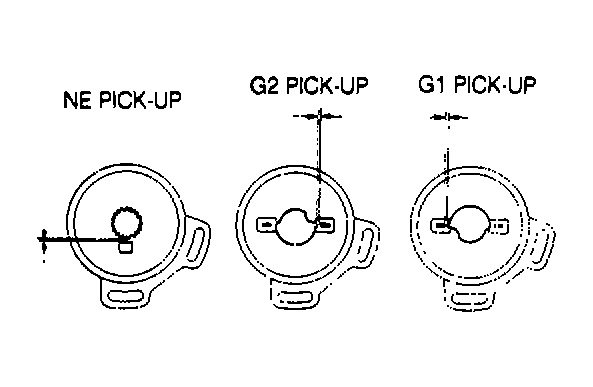 Courtesy of © TOYOTA, LICENSE AGREEMENT TMS1002
- Perform CODE 14 (step 9) trouble shooting procedures for ES250. See TESTS W/CODES
article. If voltage reading and wire harness are okay, try another ignitor.