(Test Mode)
- This mode detects the same malfunctions as normal mode. It also detects malfunctions in starter signal circuit, No. 1 and No. 2 cam position sensors, idle contact signal of TPS, A/C signal and neutral start switch signal. Test mode is more sensitive to intermittent and regular faults. This mode is used for road test conditions.
- To read diagnostic codes, ensure battery voltage is at least 11 volts, throttle valve is fully closed, transmission is in Neutral and all accessories are off. The Total Diagnostic Communication Link (TDCL) connector is located under left side of instrument panel. See Figure.
- Turn ignition off. Using a jumper, wire connect terminals E1 and TE2 together on TDCL connector. Turn ignition on. DO NOT start engine. See Fig 1.
NOTE:
If terminals E1 and TE2 are connected after ignition is turned on, Test Mode will not start.
- When ignition is turned on, CHECK engine light on instrument panel should flash. If CHECK engine light does not flash, see TERMINAL TE1 & TE2 CIRCUIT DIAGNOSIS in DIAGNOSTIC CODE CHARTS.
- Start engine. Perform road test and simulate conditions described by customer. DO NOT disconnect jumper wire connecting terminals E1 and TE2. After road test, connect terminals E1 and TE1 together on TDCL connector using a jumper wire.
- Count number of flashes from CHECK engine light. System is normal if CHECK engine light flashes 2 times every second. If a diagnostic code is displayed, first group of flashes will provide first digit of a 2-digit diagnostic code. There will be a 1.5 second delay between first digit and second digit of diagnostic code. The second group of flashes will equal second digit of diagnostic code.
- If more than one code is stored, there will be a 2.5 second delay between diagnostic codes. After all diagnostic codes have been displayed, a 4.5 second delay will occur, then diagnostic codes will be repeated until jumper wire connecting terminals E1 and TE1 is disconnected. Diagnostic codes will display starting with smallest number and go to largest.
- After completing check, disconnect terminals TE1 and TE2 from terminal E1 on TDCL connector. When entering test mode, if engine is not cranked, diagnostic Codes 17, 18 and 43 will set. This is normal. If automatic transmission is in D, 2, L or R, A/C switch is in ON position or accelerator pedal is depressed, Code 51 will set. This is normal.
- Record diagnostic codes. See DIAGNOSTIC CODE IDENTIFICATION table for description of diagnostic code and possible problem with circuit. After reading description of diagnostic code, see the appropriate diagnostic code chart. To clear codes, see CLEARING CODES in this article.
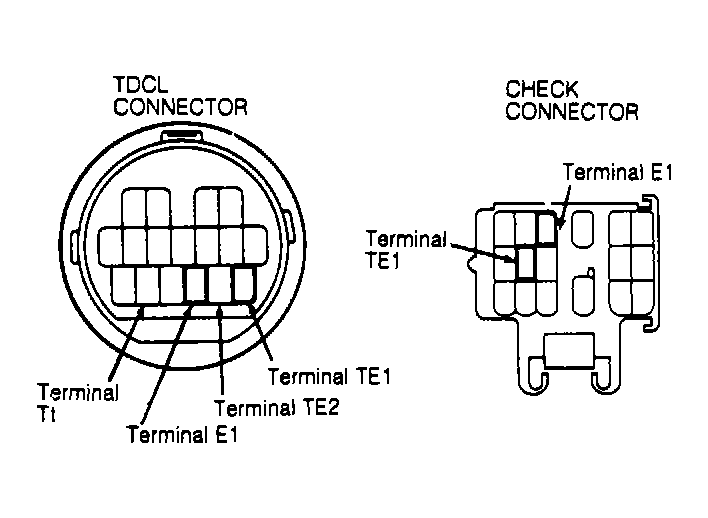 Courtesy of © TOYOTA, LICENSE AGREEMENT TMS1002
 DIAGNOSTIC CODE IDENTIFICATION
| Code |
CHECK Engine Light Normal Mode |
Signal Affected |
| 12 |
On |
RPM Circuit No. 1 |
| 13 |
On |
RPM Circuit No. 2 |
| 14 |
On |
Ignition No. 1 |
| 15 |
On |
Ignition No. 2 |
| 16 |
On |
ECT Control |
| 17 |
NA |
No. 1 Cam Position Sensor |
| 18 |
NA |
No. 2 Cam Position Sensor |
| 21 |
On |
Main Oxygen Sensor (Left Bank) |
| 22 |
On |
Water Temperature Sensor |
| 24 |
On |
Intake Air Temperature Sensor |
| 25 |
On |
Air/Fuel Ratio Lean Malfunction |
| 26 |
On |
Air/Fuel Ratio Rich Malfunction |
| 27 |
On |
Sub-Oxygen Sensor (Left Bank) |
| 28 |
On |
Main Oxygen Sensor (Right Bank) |
| 29 |
On |
Sub-Oxygen Sensor (Right Bank) |
| 31 |
On |
Airflow Meter |
| 35 |
On |
HAC Sensor |
| 41 |
On |
Throttle Position Sensor |
| 43 |
NA |
Starter |
| 47 |
On |
Sub-Throttle Position Sensor |
| 51 |
NA |
Switch Condition |
| 52 |
On |
No. 1 Knock Sensor |
| 53 |
On |
Knock Control |
| 55 |
On |
No. 2 Knock Sensor |
| 71 |
On |
EGR System Malfunction |