Spark Test
- Disconnect coil wire from distributor(s). Using insulated pliers, hold end of coil wire 1/2" from ground. Crank engine for 1-2 seconds. If spark is not present, go to next step. If spark is present at coil wire but not at spark plug wire, replace faulty distributor rotor, cap, wires or spark plugs as necessary.
- Turn ignition off. Check for poor electrical connections at ignition coil, ignitor and distributor. Repair as necessary. If connections are okay, check resistance of coil wire and spark plug wires. Maximum allowable resistance is 25,000 ohms per wire.
- If resistance is okay, turn ignition on. Disconnect ignition coil connector. Measure voltage between ground and positive terminal at ignition coil connector. See IGNITION COIL POSITIVE TERMINAL IDENTIFICATION table. If battery voltage is not present, check for open or grounded wire between battery and ignition coil or open fuse, also check for faulty ignition main relay.
- If battery voltage is present, turn ignition off. Measure ignition coil resistance. To measure primary resistance, measure resistance between terminals of ignition coil. To measure secondary resistance, measure resistance between positive wire terminal at ignition coil and coil secondary tower. If resistance is not as specified, replace ignition coil. See IGNITION COIL RESISTANCE table.
IGNITION COIL POSITIVE TERMINAL IDENTIFICATION
| Application |
Wire Color |
| SC300 |
Black/White |
IGNITION COIL RESISTANCE
| Application |
Primary |
Secondary |
| SC300 |
| Cold |
.21-.33 |
6400-11,100 |
| Hot |
.27-.39 |
8200-13,000 |
- If resistance is as specified, check resistance across terminals of the following distributor sensor.
- Distributor pick-up coil. See Fig 1.
- If resistance is not as specified, replace distributor housing. See DISTRIBUTOR SENSOR RESISTANCE table. If resistance is as specified, go to next step.
- Measure air gap of pick-up coils G1, G2 and NE. See Fig 2. See DISTRIBUTOR PICK-UP COIL AIR GAP table. If air gap is within specification, go to next step. If air gap is not within specification, replace distributor.
- Check ignition IGT signal from Engine Control Module (ECM). If IGT signal from ECM is defective a Diagnostic Trouble Code (DTC) should set in ECM memory. See testing procedure for DTC P1300 in TESTS W/CODES
article. If IGT signal circuit is okay, substitute another ignitor and recheck system operation.
DISTRIBUTOR SENSOR RESISTANCE
| Application |
Ohms |
| SC300 (Pick-Up Coils) |
| Cold |
| Between Terminals G1 & "G-" |
125-200 |
| Between Terminals G2 & "G-" |
125-200 |
| Between Terminals NE & "G-" |
155-250 |
| Hot |
| Between Terminals G1 & "G-" |
160-235 |
| Between Terminals G2 & "G-" |
160-235 |
| Between Terminals NE & "G-" |
190-290 |
DISTRIBUTOR PICK-UP COIL AIR GAP
| Application |
In. (mm) |
| SC300 |
.008-.020 (.20-.50) |
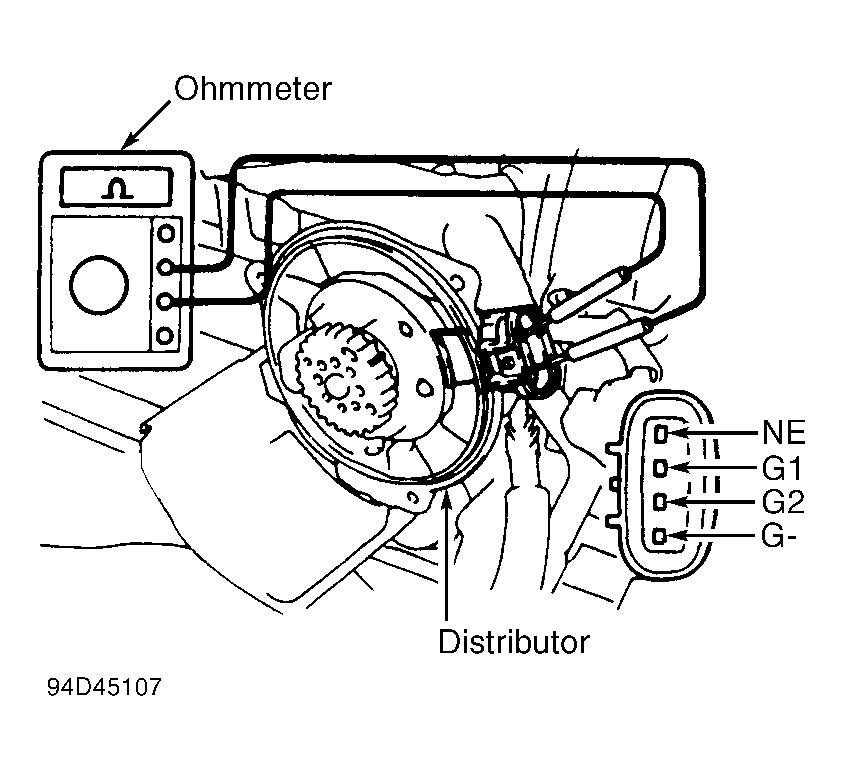 Courtesy of © TOYOTA, LICENSE AGREEMENT TMS1002
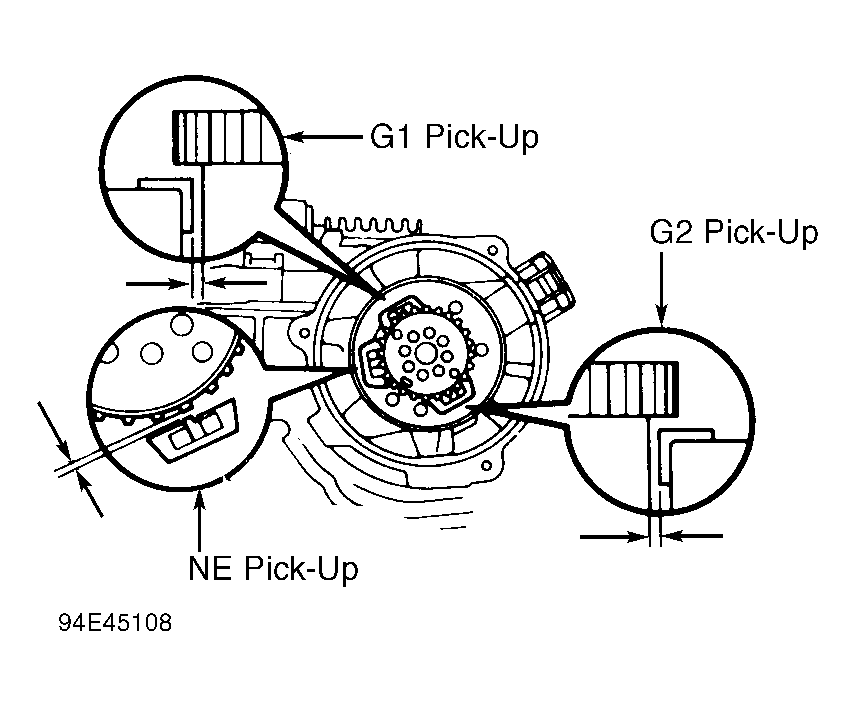 Courtesy of © TOYOTA, LICENSE AGREEMENT TMS1002