Throttle Body
- Remove engine cover.
- To check throttle control motor operation, turn ignition on. Press accelerator pedal while listening for operating sound at throttle control motor. Ensure that no grinding noise is heard at throttle control motor or throttle body.
- If throttle control motor operating sound is heard, go to next step. If throttle control motor operating sound is not heard or grinding noise is heard, throttle control motor, wiring harness or Engine Control Module (ECM) may be defective. ECM is located behind glove box. Go to step 10 for testing of throttle control motor.
- If you do not have hand-held tester, go to step 7. Connect scan tool to Data Link Connector (DLC) No. 3. See Figure. Scan tool is used to read throttle valve opening which is displayed as a percentage. Ensure Malfunction Indicator Light (MIL) on instrument panel is not illuminated. If MIL is not illuminated, go to next step. If MIL is illuminated, a Diagnostic Trouble Code (DTC) may be stored in Engine Control Module (ECM). Retrieve DTCs and perform appropriate diagnostic test. See SELF-DIAGNOSTICS - GX470
article.
- Press accelerator pedal to full throttle while reading throttle valve opening on scan tool which is accessed by THROTTLE POS under CURRENT DATA. Throttle valve opening should be at least 60 percent.
- If throttle valve opening is not at least 60 percent, problem may exist in accelerator pedal position sensor, wiring circuit or ECM. Go to step 12 for testing of accelerator pedal position sensor.
- If you do not have a hand-held tester, access ECM behind glove box. Ensure ignition is turned on. Using voltmeter, check voltage between ECM terminals VTA1-E2 and VTA2-E2. See Fig 1.
- Start engine and check that MIL does not illuminate. Let engine warm up to normal operating temperature. Switch A/C compressor off and check idle speed. With transmission in neutral, idle speed should be 650-750 RPM.
- If all previous steps have been performed, drive vehicle to verify proper operation of throttle body.
- To test throttle control motor, disconnect electrical connector at throttle control motor.
- Using ohmmeter, check resistance between terminals M+ and M- on throttle control motor. See Fig 2. Motor resistance should be .3-100 ohms at 68°F (20°C). If resistance is within specification, reinstall electrical connector. Go to next step. If resistance is not within specification, replace throttle control motor. See THROTTLE CONTROL MOTOR
under MOTORS in REMOVAL & INSTALLATION - GX470 article.
- To test accelerator pedal position sensor without hand-held tester, see step 13. Connect hand-held tester to DLC3. See Figure. Turn ignition switch on. Check voltage (ACCEL POS) of CURRENT DATA. With accelerator pedal released, voltage should be .5-1.1 volts. With accelerator pedal depressed, voltage should be 2.6-4.5 volts. Check voltage (ACCEL POS #2) of CURRENT DATA. With accelerator pedal released, voltage should be 1.2-2 volts. With accelerator pedal depressed, voltage should be 3.4-5.3 volts. If voltage is not to specification, repair or replace as necessary.
- To test accelerator pedal position sensor without hand-held tester, measure voltage between terminals VPA-EPA and VPA2-EPA2 of ECM connector. See Fig 1. If voltage is not to specification, repair or replace as necessary.
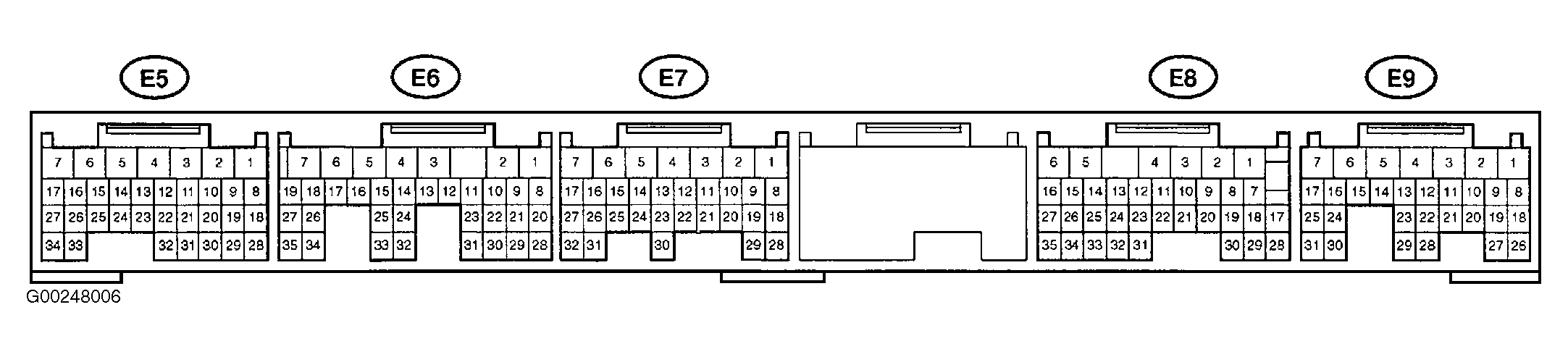 Courtesy of © TOYOTA, LICENSE AGREEMENT TMS1002
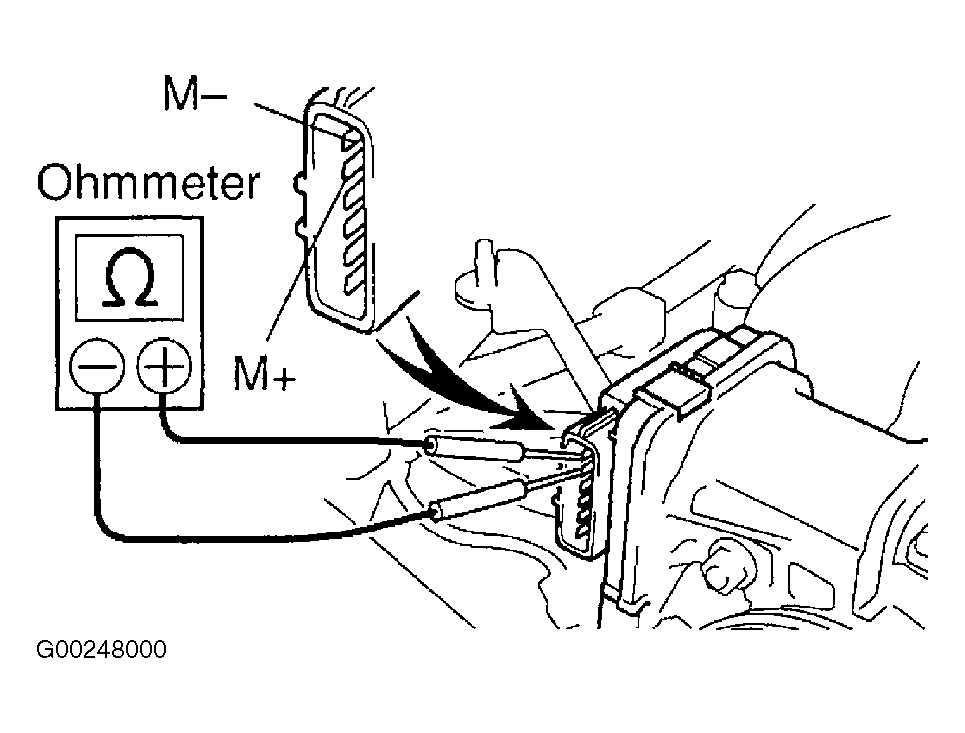 Courtesy of © TOYOTA, LICENSE AGREEMENT TMS1002