Lack/Loss Of Power-Acceleration/Cruise (Us): Notes
LACK/LOSS OF POWER - ACCELERATION/CRUISE (SKYACTIV-G, US) DESCRIPTION AND POSSIBLE CAUSE
| Troubleshooting item |
Lack/Loss of power-acceleration/cruise |
| Description |
- Engine speed increase delays when the accelerator pedal is fully depressed.
|
| Possible cause |
- Engine overheating
- Drive-by-wire control system operates with brake override system
- PCM DTC is stored
- Erratic signal to PCM
- APP sensor or related circuit malfunction
- Clutch stroke sensor or related circuit malfunction (MTX)
- Communication error between TCM and PCM (ATX)
- ECT sensor No. 1 or related circuit malfunction
- ECT sensor No. 2 or related circuit malfunction
- Fuel pressure sensor or related circuit malfunction
- IAT sensor No. 1 (integrated in MAF sensor/IAT sensor No. 1) or related circuit malfunction
- MAF sensor or related circuit malfunction
- MAP sensor or related circuit malfunction
- A/F sensor or related circuit malfunction
- HO2S or related circuit malfunction
- Improper operation of A/C system
- Improper operation of drive-by-wire control system
- Throttle body malfunction
- Incorrect fuel injection timing
- Fuel injector malfunction
- Purge solenoid valve malfunction
- Fuel leakage
- Poor fuel quality
- Air leakage or restriction in intake-air system
- Vacuum leakage
- Air cleaner restricted or dirty
- Clutch slippage (MTX)
- Brake dragging
- Improper tire air pressure
- Erratic signal from CKP sensor
- Loose installation
- Damaged trigger wheel (crankshaft pulley)
- Open or short circuit in related wiring harness
- Erratic or no signal from CMP sensor
- Loose installation
- Damaged trigger wheel (intake camshaft)
- Damaged trigger wheel (exhaust camshaft)
- Open or short circuit in related wiring harness
- Inadequate fuel pressure (high or low pressure side)
- Fuel pressure sensor malfunction
- High pressure fuel pump malfunction
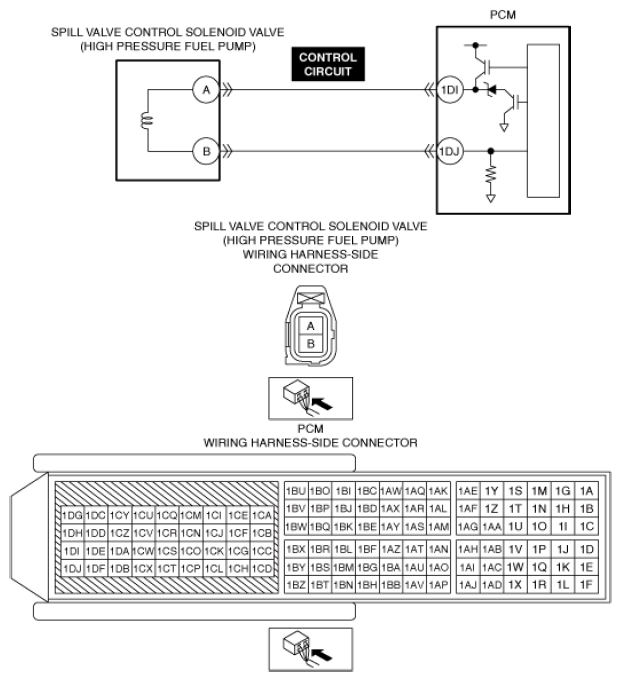
- Spill valve control solenoid valve control circuit malfunction (damage to driver in PCM caused by short circuit to ground system)
- Spill valve control solenoid valve malfunction (built-into high pressure fuel pump)
- Relief valve (built-into high pressure fuel pump) malfunction
- Fuel line restricted or clogged
- Fuel filter clogged (built-into fuel pump unit)
- Fuel pump mechanical malfunction
- Throttle valve restricted or clogged
- Low engine compression
- Improper intake valve timing
- Improper exhaust valve timing
- Improper operation of electric variable valve timing control system
- Electric variable valve timing driver malfunction
- Electric variable valve timing motor malfunction
- Electric variable valve timing actuator malfunction
- Improper operation of hydraulic variable valve timing control system
- Spark plug malfunction
- Ignition coil malfunction
- Exhaust system and/or TWC restriction
- PCV valve malfunction
- Injector driver (built-into PCM) malfunction
- ATX internal malfunction (ATX)
|
| Possible cause |
WARNING:
- The following troubleshooting flow chart contains the fuel system diagnosis and repair procedures. Read the following warnings before performing the fuel system services:
- Fuel may cause irritation if it comes in contact with skin and eyes.
- If fuel ignites and causes a fire, it may lead to serious injury or death, and damage to property and facilities.
CAUTION:
- Disconnecting/connecting the quick release connector without cleaning it may possibly cause damage to the fuel pipe and quick release connector. Always clean the quick release connector joint area before disconnecting/connecting, and make sure that it is free of foreign material.
|
 Courtesy of MAZDA MOTORS CORP. Courtesy of MAZDA MOTORS CORP.
|
CAUTION:
- Verify the malfunction symptom according to not only the PID value but also the symptom troubleshooting.