Electronic Control Module (ECM) Power & Ground Circuit Test
- Attempt to start engine. If engine starts, go to step 4). If engine does not start, go to next step.
- Turn ignition on. Locate ECM under center of instrument panel (connector is on driver's side). Measure voltage between ground and ECM harness connector terminal No. 38 (Black/Red wire). See Fig 1
. Battery voltage should be present.
- If battery voltage is not present, check wiring harness and connectors between ECM and ignition switch. Repair or replace as necessary. If battery voltage is present, go to step 12).
- Turn ignition (engine) off. Locate ECM under center of instrument panel (connector is on driver's side). Measure voltage between ground and ECM harness connector terminal No. 70 (White/Blue wire). Battery voltage should be present.
- If battery voltage is not present, check fusible link (7.5-amp). Also check wiring harness and connectors between ECM, fusible link, and battery. Repair or replace as necessary. If battery voltage is present, go to next step.
- Turn ignition on, then off. Measure voltage between ground and ECM harness connector terminal No. 56 (White/Red wire), and between ground and terminal No. 61 (White/Red wire).
- Battery voltage should exist for a few seconds after turning ignition off, then voltage should drop to near zero. If voltage is as specified, go to step 12). If battery voltage exists for more than a few seconds, go to step 11). If battery voltage does not exist, go to next step.
- Turn ignition off. Disconnect ECM harness connector. Remove ECM (ECCS) relay. Relay is located underneath ECM. Check continuity between ECM harness connector terminal No. 56 (White/Red wire), terminal No. 61 (White/Red wire), and relay connector terminal No. 5 (White/Red wire). Continuity should exist. If continuity exists, go to next step. If continuity does not exist, repair harness and connectors between ECM and ECCS relay.
- Remove ECM (ECCS) relay. Measure voltage between ground and relay connector terminal No. 1 (White/Blue wire) and terminal No. 3 (White/Blue wire). Battery voltage should be present. If battery voltage is present, go to next step. If battery voltage is not present, check fusible link (7.5-amp). Also check harness and connectors between relay and battery.
- Check continuity between ECM harness connector terminal No. 4 (White/Green wire) and ECCS relay connector terminal No. 2 (White/Green wire). Continuity should exist. If continuity exists, go to next step. If continuity does not exist, repair harness between ECM harness connector and relay.
- Check ECM (ECCS) relay. Relay is located underneath ECM. See RELAYS
under RELAYS & SOLENOIDS. If necessary, replace relay. If relay is okay, go to next step.
- Turn ignition off. Disconnect ECM harness connector. Check continuity between ground and ECM harness connector terminals No. 10 (Black wire), No. 19 (Black wire), No. 39 (Black wire), No. 43 (Black wire), No. 106 (Black wire), No. 112 (Black wire), and terminal No. 118 (Black wire). Continuity should exist at all terminals. If continuity does not exist, check chassis and engine ground connections. If ground connections are okay, repair harness or connectors.
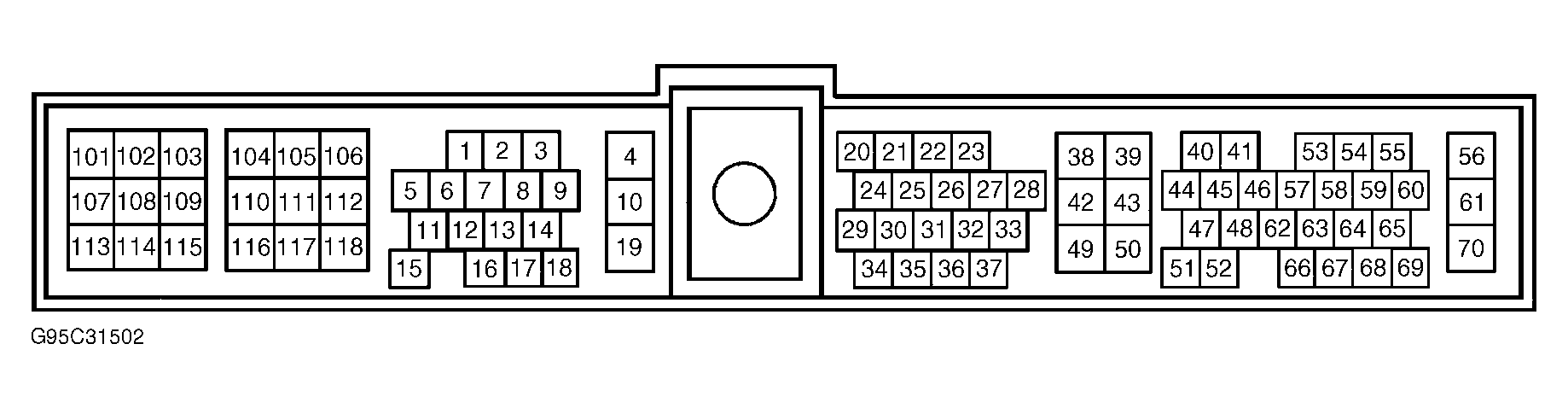 Courtesy of NISSAN MOTOR CO., U.S.A.