System Tests
- Remove secondary wire from distributor center tower. Hold end of wire approximately 3/8" from a good engine ground. Crank engine and check for a bright blue spark at gap. See Fig 1.
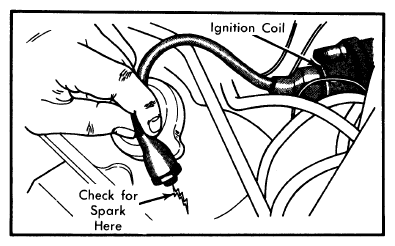 Courtesy of CHRYSLER GROUP, LLC
- If spark occurs, slowly move secondary wire away from ground, checking for arcing at coil tower. If arcing occurs, replace ignition coil.
- If spark was good and there was no arcing at coil tower, secondary voltage is good. Check distributor rotor and cap for damage, as well as, secondary wires and spark plugs. If all components are okay, check fuel system or check for mechanical damage to engine components.
- If in step 2) spark was weak, not constant, or there was no sparking, turn ignition switch on. Connect voltmeter positive lead to ignition coil negative terminal. Connect negative lead to a good ground. Voltage reading should be within 1 volt of battery voltage. If reading is less than 3 volts, the distributor is defective. If there is no voltage indicated, check for open circuit in ignition coil or wiring harnesses.
- If battery voltage was indicated in step 4), hold coil secondary wire about 3/8" from a good ground. See Fig 2. Using a special jumper wire assembly, momentarily touch ignition coil negative terminal to ground. A spark should result.
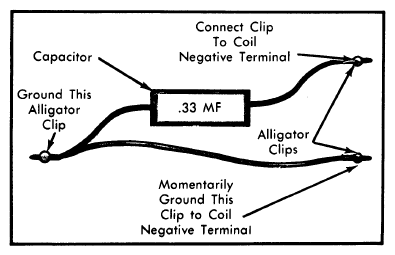 Courtesy of CHRYSLER GROUP, LLC
- If there was no spark, check for voltage at positive terminal of ignition coil with ignition switch on (voltmeter positive lead to positive terminal, negative lead to ground). Reading should be at least 12 volts. If proper voltage is read, ignition coil is defective and must be replaced. If voltage was not to specifications, check wiring back to battery.
- If in step 5) a spark was produced, but vehicle will not start, replace distributor.