Airflow Meter
- Visual check for leaks, foreign matter, or damage in air intake boot and airflow meter. Repair or replace if any damage is found. Using a DVOM, measure resistance between body and ground terminals "B" and "BR". See Fig 1
.
- Resistance should be 10 ohms maximum. If resistance is greater than specified, check harness and internal circuits of control unit for zero continuity. Check ground terminal on intake manifold for poor connection.
- Turn ignition on (engine off). Connect airflow meter connector. Measure voltage across power terminal "R" on XT models ("SA" on Wagon, Coupe and Sedan models) and body. Reading should be 10 volts minimum.
- If voltage is not within specifications, check condition of parts in power circuit. Attach positive lead of voltmeter to signal terminal "W" on XT models ("SA" on Wagon, Coupe and Sedan models) and negative lead to ground terminal "BR". Voltage should be 1-2 volts.
- If not within specifications, replace airflow meter. If voltage is within specifications, remove airflow meter from air cleaner. Blow air from air cleaner side to check if voltage across terminals "W" on XT models ("SA" on Wagon, Coupe and Sedan models) and "BR" on XT models ("B" on Wagon, Coupe and Sedan models) is greater than that measured in step 4).
- If not, replace airflow meter. Install airflow meter on air cleaner. Start engine, and warm until coolant temperature reaches approximately 176°F (80°C). Drive at speed greater than 15 MPH for at least one minute.
- Run engine at speeds greater than 2000 RPM. While idling engine, measure voltage across terminal "LgR" of airflow meter connector and body. Zero volts under normal operating conditions is okay.
- Turn ignition off. If 12 volts are present, check across terminal "LgR" and body for one second shortly after ignition has been turned off.
- If 12 volts is not present, check harness from control unit to airflow meter for discontinuity.
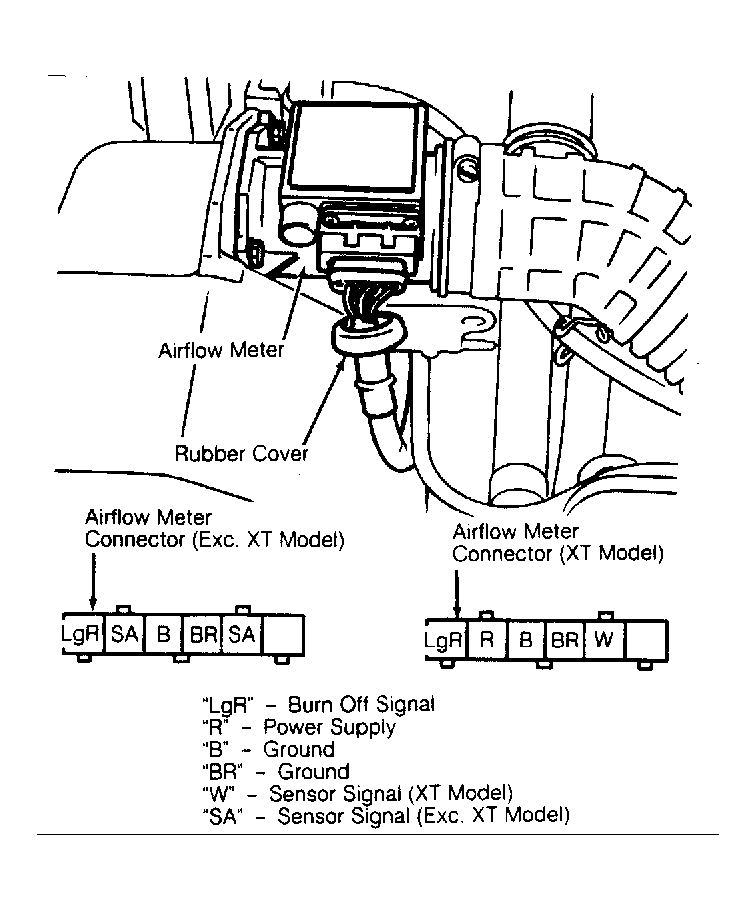 Courtesy of SUBARU OF AMERICA, INC.