2.2L & 2.5L
- Remove spark plug wires from spark plugs. Leave original spark plug installed in cylinder head. Install new spark plug to plug wire. Ground spark plug against cylinder block.
- Crank engine with throttle valve fully open and check for spark. If spark does not exist, go to next step. If spark exists, check fuel pump operation. See FUEL PUMP OPERATION
under FUEL SYSTEMS.
- Turn ignition off. Disconnect 4-pin electrical connector from ignition coil and ignitor assembly. Turn ignition on. Using a DVOM, measure power supply voltage between ignition coil and ignitor assembly electrical connector terminal No. 2 and ground. See Fig 1
. If voltage is more than 10 volts, go to next step. If voltage is not more than 10 volts, check for open circuit between ignition coil and ignitor assembly and battery.
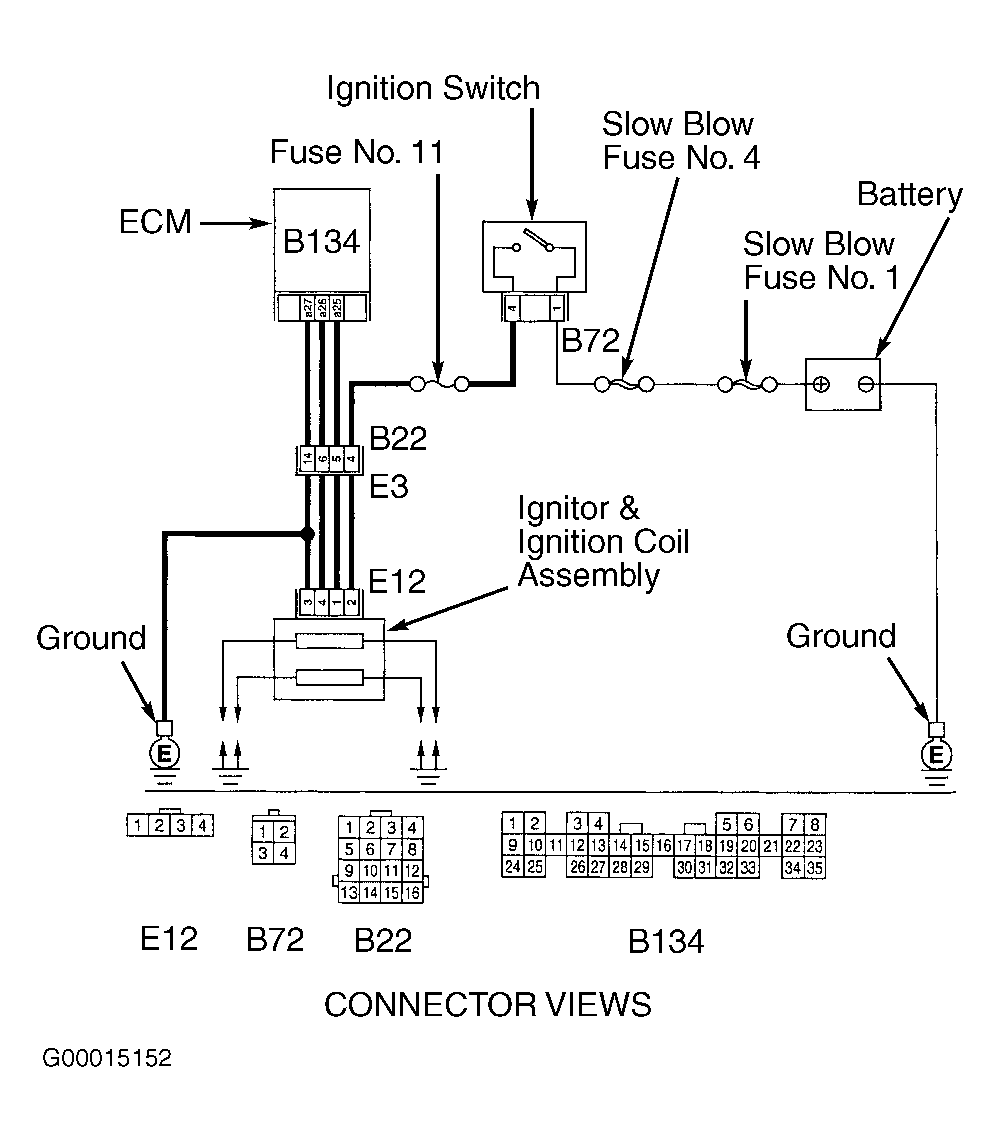 Courtesy of SUBARU OF AMERICA, INC.
- Turn ignition off. Using a DVOM, measure resistance of ground circuit between ignition coil and ignitor assembly electrical connector terminal No. 3 and ground. See Fig 1
. If resistance is less than 5 ohms, go to next step. If resistance is not less than 5 ohms, check for open circuit between ignition coil and ignitor assembly and ground point.
- Check ignition coil and ignitor assembly. See IGNITION COIL RESISTANCE
. If ignition coil and ignitor assembly is okay, go to next step. If ignition coil and ignitor assembly is defective, replace unit and retest for spark. See IGNITION SYSTEMS in REMOVAL, OVERHAUL & INSTALLATION article.
- Check resistance of camshaft position sensor. See CAMSHAFT POSITION SENSOR RESISTANCE
. If camshaft position sensor resistance is within specification, go to next step. If camshaft position sensor resistance is not within specification, replace camshaft position sensor and retest for spark. See IGNITION SYSTEMS in REMOVAL, OVERHAUL & INSTALLATION article.
- Check resistance of crankshaft position sensor. See CRANKSHAFT POSITION SENSOR RESISTANCE
. If crankshaft position sensor resistance is within specification, go to next step. If crankshaft position sensor resistance is not within specification, replace crankshaft position sensor and retest for spark. See IGNITION SYSTEMS in REMOVAL, OVERHAUL & INSTALLATION article.
- Reconnect 4-pin electrical connector to ignition coil and ignitor assembly. Using an oscilloscope, backprobe between ignition coil and ignitor assembly 4-pin electrical connector terminals No. 1 and No. 4 and ground while cranking engine. See Fig 1
. If voltage is more than 10 volts and varies synchronously with engine speed, go to next step. If voltage is not more than 10 volts and does not vary synchronously with engine speed, replace ignition coil and ignitor assembly.
- Turn ignition off. Disconnect 35-pin ECM connector and 4-pin ignition coil and ignitor assembly connector. Using a DVOM, measure resistance between 35-pin ECM connector terminal No. 25 and 4-pin ignition coil and ignitor assembly connector terminal No. 1. Also measure resistance between 35-pin ECM connector terminal No. 26 and 4-pin ignition coil and ignitor assembly connector terminal No. 4. If resistance is less than one ohm for each circuit, go to next step. If resistance is not less than one ohm for each circuit, repair open circuit or poor connector contact in wiring harness between ECM and ignition coil and ignitor assembly.
- Using a DVOM, measure resistance between 35-pin ECM connector terminals No. 25 and No. 26 and ground. If resistance is more than 1 megohm, go to next step. If resistance is not more than 1 megohm, repair short in ECM wiring harness between ECM and ignition coil and ignitor assembly.
- Check for poor terminal contact in 35-pin ECM connector. If 35-pin ECM connector terminal contact is okay, check fuel pump operation. See FUEL PUMP OPERATION
under FUEL SYSTEMS. If 35-pin ECM connector terminal contact is not okay, repair as required and retest system.