DTC P0462: Fuel Level Sensor Circuit Low Input
- Perform basic diagnostic procedure. See BASIC DIAGNOSTIC PROCEDURE
. Check speedometer and tachometer operation. If speedometer and tachometer operate normally, go to next step. If speedometer and tachometer do not operate normally, repair or replace instrument cluster.
- Turn ignition on. Using DVOM connected to ground, backprobe ECM connector B135 (28-pin connector) terminal No. 25. See Figure
. If voltage is not less than 0.12 volt, go to next step. If voltage is less than 0.12 volt, go to step 4
.
- Using scan tool, read fuel level sensor signal while wiggling harness and ECM connector. If voltage changes less than 0.12 volt while wiggling harness and ECM connector, repair poor terminal contact in ECM connector. If voltage does not change less than 0.12 volt while wiggling harness and ECM connector, circuit has returned to normal. Check for poor terminal contact in connectors between instrument cluster and ECM.
- Turn ignition off. Remove service hole cover located in left rear of luggage compartment floor. Disconnect Black 6-pin in-line connector located between rear wiring harness and fuel tank harness (nearest fuel tank). Turn ignition on. Using DVOM connected to ground, backprobe ECM connector B135 (28-pin connector) terminal No. 25. If voltage is not more than 0.12 volt, go to step 7
. If voltage is more than 0.12 volt, go to next step.
- Turn ignition off. Disconnect ECM connector B135 (28-pin connector) and 30-pin instrument panel electrical harness connector. See Fig 1
. Using an ohmmeter connected to ground, backprobe ECM connector B135 (28-pin connector) terminal No. 25. If resistance is more than one megohm, go to next step. If resistance is not more than one megohm, locate and repair short to ground in wiring between ECM and instrument cluster. See WIRING DIAGRAMS article.
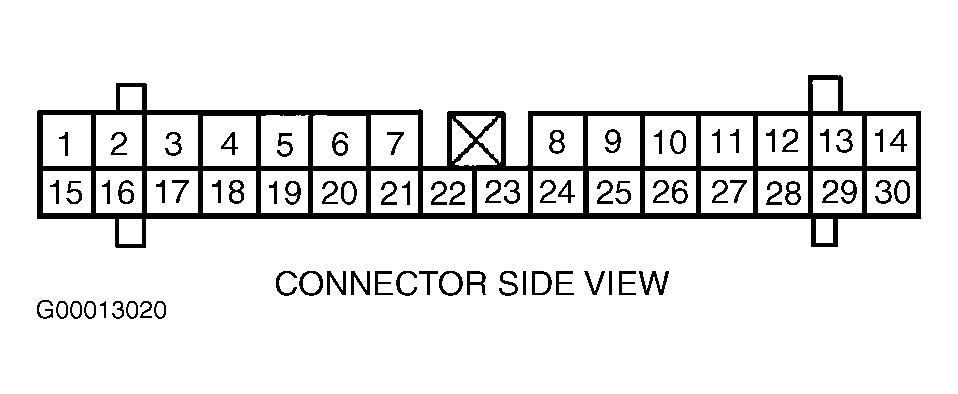 Courtesy of SUBARU OF AMERICA, INC.
- Measure resistance between ECM connector B135 (28-pin connector) terminal No. 25 and 30-pin instrument cluster connector terminal No. 3. If resistance is not less than 10 ohms, locate and repair open circuit in wiring and check for poor terminal contact in connectors between ECM and instrument cluster. If resistance is less than 10 ohms, repair or replace instrument cluster.
- Turn ignition off. Disconnect fuel sub level sensor 2-pin connector. Measure resistance between ground and fuel sub level sensor connector terminal No. 1. See Fig 2
. If resistance is more than one megohm, go to next step. If resistance is not more than one megohm, locate and repair short to ground in fuel tank harness.
- Disconnect electrical connector at fuel pump. With fuel sub level sensor 2-pin connector still disconnected, use ohmmeter to measure resistance between ground and fuel sub level sensor connector terminal No. 2. If resistance is not more than one megohm, locate and repair short to ground in fuel tank harness. If resistance is more than one megohm, go to next step.
- Remove fuel pump assembly from fuel tank. With fuel level sensor float set to full position, measure resistance between terminals No. 3 and No. 6 of fuel level sensor. If resistance is between 0.5 and 2.5 ohms, go to next step. If resistance is not between 0.5 and 2.5 ohms, replace fuel level sensor.
- Remove fuel sub level sensor. With fuel sub level sensor float set to full position, measure resistance between terminals of fuel sub level sensor. If resistance is between 0.5 and 2.5 ohms, repair poor terminal contact in connectors between ECM and instrument cluster. If resistance is not between 0.5 and 2.5 ohms, replace fuel sub level sensor. Clear memory and perform verification procedure. See CLEARING DIAGNOSTIC TROUBLE CODES
and VERIFICATION PROCEDURE
.
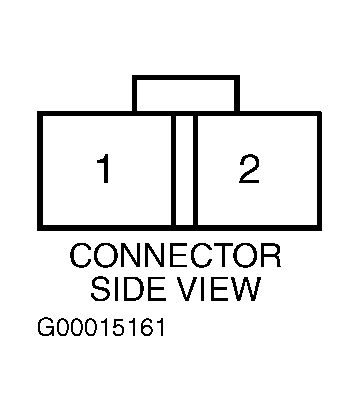 Courtesy of SUBARU OF AMERICA, INC.