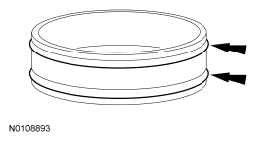
- Install 2 new O-rings on the new servo cover and lubricate them with clean transmission fluid.
 Courtesy of FORD MOTOR CO.
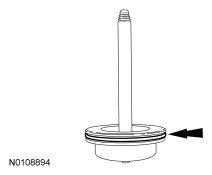
- Install a new O-ring on the servo piston and lubricate it with clean automatic transmission fluid.
 Courtesy of FORD MOTOR CO.
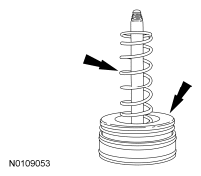
- Position the servo spring on the piston and install the servo piston in the servo cover.
NOTE:
The piston will rest on top of the servo.
 Courtesy of FORD MOTOR CO.
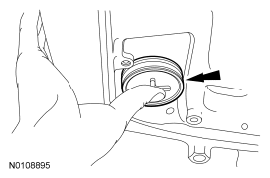
- Position the servo in place in the servo bore.
 Courtesy of FORD MOTOR CO.
- Using a suitable tool and an adjustable jackstand, compress the servo spring. Install the servo and the snap ring into the transaxle case with the snap ring gap facing the right (engine side) of the transaxle.
NOTE:
Shake the servo cover when installing the servo to help align it in the bore or damage to the O-ring can result causing a leak.
NOTE:
Install the snap ring with the bevel facing down or the snap ring can come loose causing damage to the transaxle.
NOTE:
Position the snap ring under the servo cover before positioning the tool used to push the servo in the transaxle case.
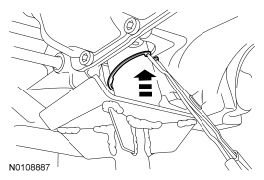 Courtesy of FORD MOTOR CO.
- Inspect the snap ring to be sure it is fully seated in the snap ring groove. Be sure that the snap ring gap is facing right.
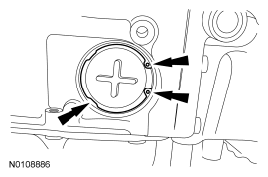 Courtesy of FORD MOTOR CO.
- Install the underbody cover and the screws.
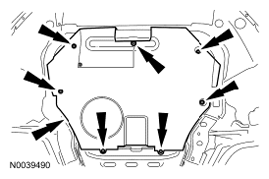 Courtesy of FORD MOTOR CO.
- Slowly fill the transaxle through the transmission fluid level indicator tube with approximately 1.9L (2 qt) of clean transmission fluid.
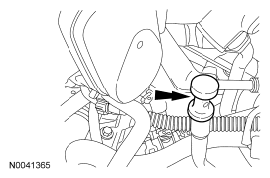 Courtesy of FORD MOTOR CO.
- With the transaxle in PARK, the vehicle on a level surface, the engine at idle (680-780 rpm) and foot pressed on the brake, move the selector lever through each gear and allow engagement of each gear. Place the selector lever back in the PARK position.
- Wipe the transmission fluid level indicator with a clean cloth.
- If transmission fluid needs to be added, add transmission fluid in 0.25L (1/2 pt) increments through the transmission fluid level indicator tube. Do not overfill the transmission fluid. Install the transmission fluid level indicator back in the transmission fluid filler tube until it is fully seated, then remove the transmission fluid level indicator. The transmission fluid level should be at the upper most mark on the transmission fluid level indicator. Only fill to the upper most mark on the transmission fluid level indicator. Do not overfill. Damage to the transaxle will occur.
NOTE:
In order to get an accurate transmission fluid level reading, the vehicle should be on a level surface. Idle the engine to reach the normal operating temperature. Using the scan tool, verify that the transaxle is at normal operating temperature 60°C-70°C (140°F-158°F), prior to adjusting the transmission fluid level.
Courtesy of FORD MOTOR CO.
- Fill the transaxle to the correct transmission fluid level.
NOTE:
The correct transmission fluid level at normal operating temperature of 60°C-70°C (140°F-158°F) is between the top 2 marks on the transmission fluid level indicator.
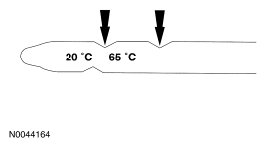 Courtesy of FORD MOTOR CO.
- If the Transmission Fluid Temperature (TFT) is low, fill the transaxle with transmission fluid to the cold range on the transmission fluid level indicator. Recheck the transmission fluid level when the transaxle has reached the normal operating temperature.
NOTE:
The correct transmission fluid level at cool operating temperature of 15°C-25°C (59°F-77°F), is at the bottom mark on the transmission fluid level indicator.
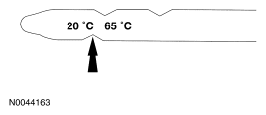 Courtesy of FORD MOTOR CO.